26 November 2026
Celebrating Our Members’ Impact: Bees for Development

The work of SWIDN members spans the globe, with organisations working alongside partners and communities on a diverse range of causes. It’s a privilege to help amplify their work and bring together a network where we can share knowledge, learn from one another and explore opportunities for collaboration.
As part of our commitment to celebrating the work of our members, we’re highlighting the recently published 2025–2026 Impact Report from Bees for Development, sharing a year of work with partners and beekeeping communities around the world.
With over 30 years of experience, the organisation advocates for nature-based beekeeping as a means of strengthening sustainable livelihoods, protecting biodiversity and addressing poverty. Its approach is rooted in local knowledge, established beekeeping practices and long-term partnerships.
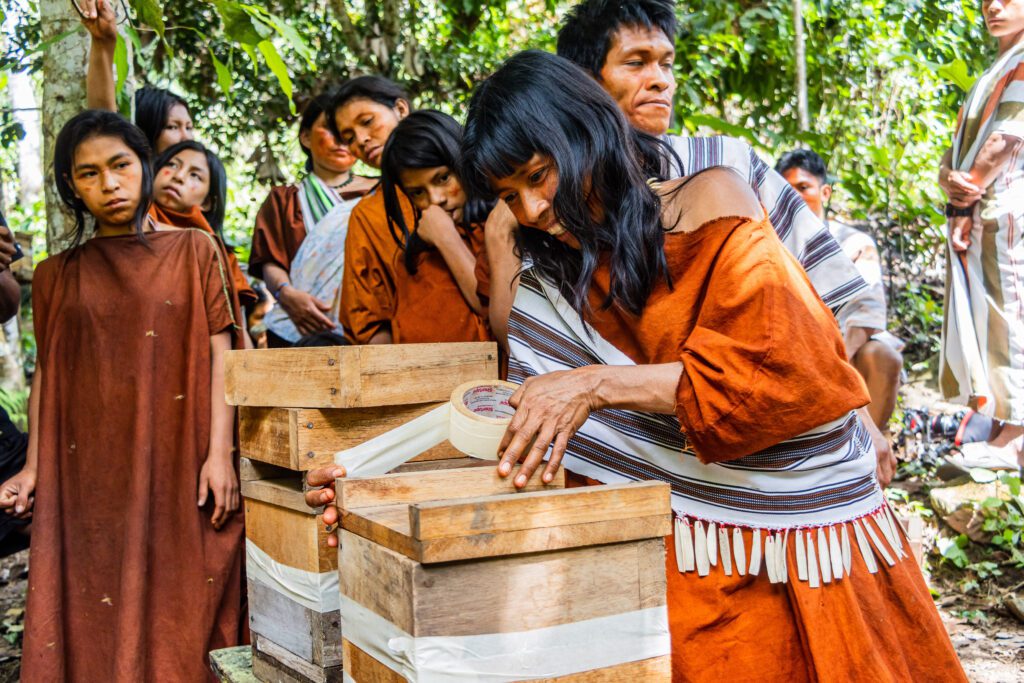
Photo credit: Bees For Development
A year of impact
In 2025, Bees for Development and its partners reported:
- 2,233 people trained or mentored in beekeeping across six countries.
- 80,000 trees planted by partners in Uganda, Ethiopia and Zimbabwe.
- 599 people from marginalised groups trained.
- 1,131 people trained in biodiversity management practices.
- 130,874 people reached through its online Resource Centre.
- 13,786kg of honey sold directly through free digital traceability systems developed by Bees for Development.
Making beekeeping more accessible
Economic inclusion is a priority for Bees for Development and its partners, with particular attention to the barriers faced by women, Indigenous communities and people with disabilities.
In Uganda, Kasule Matia received beekeeping training through the Uganda National Apiculture Development Organisation (TUNADO). Now an Apiary Master in Jinja, Kasule, who communicates using sign language, provides practical training and has established a support group for other deaf and hearing-impaired beekeepers. Members have harvested and sold their own honey, generating additional income and creating a space to share knowledge and experiences.
In the Peruvian Amazon, Indigenous communities have identified opportunities to develop livelihoods connected to their traditional knowledge and biodiversity conservation. Through a partnership with Amazon Research Internacional, 263 members of the Ashaninka and Kukama-Kukamiria communities received training in stingless beekeeping. Indigenous beekeepers are combining ancestral knowledge with conservation practices to generate income, protect native pollinators and preserve cultural identity.
Sustainable livelihoods and biodiversity
Beekeepers play an important role in protecting the ecosystems on which their livelihoods depend.
In Ghana, beekeeping communities are taking measures to prevent dry-season bushfires, with 110 fire management volunteers trained in 2025. Between 2021 and 2025, fire incidence across the Afram Plains decreased by 31% compared with the previous five years, despite drought and drier conditions.
The report also identifies a 25% increase in vegetation health and density in areas surrounding apiary sites in Ghana between 2019 and 2025, compared with areas outside them.
These findings highlight the relationship between sustainable livelihoods, community-led conservation and biodiversity.
Strengthening local organisations and sharing knowledge
Long-term partnerships are central to Bees for Development’s approach. In 2025, the organisation worked with six specialist beekeeping organisations, providing funding, technical expertise and organisational support to strengthen their capacity to operate independently.
A significant milestone was the official registration of the Malawi Bee Products Association, which brought together 40 beekeeping organisations from across the country at its annual general and stakeholder meeting.
Bees for Development is also facilitating knowledge exchange between its international partners. The report outlines plans for its Ghanaian partner to receive specialist disability inclusion training from its Ugandan partner in 2026, drawing on established expertise and experience within the network.
As Bees for Development develops its next organisational strategy, strengthening local organisations, facilitating collaboration between partners and recognising local expertise remain central to its ambitions.
We’re pleased to celebrate the work of Bees for Development, its partners and the beekeeping communities featured throughout the report.
Read the full Bees for Development 2025–2026 Impact Report here.
Share your impact with the SWIDN community
There is a wealth of knowledge, experience and learning across our network, and we’d love to create more opportunities for members to share this with one another.
Whether you’ve recently published an impact report, reached a project milestone or have a story or learning to share, we’d love to hear from you.
We welcome contributions from organisations of all sizes and are particularly keen to amplify the voices, experiences and achievements of the communities and partner organisations you work alongside.
Get in touch with the SWIDN team to share your work and help us celebrate the collective impact of our network.
More News

Can AI help us listen more closely to communities?
By Gabriele Caldas Cabral and Steve Powell, Causal Map How can we measure the impact of development programmes without losing the voices and experiences of the people they’re designed to support? As conversations around the ethical implications of AI continue across the global justice space, its potential role in monitoring and evaluation raises both opportunities…
Supporting Indigenous-led conservation: Lessons from the Peruvian Amazon
New research from the University of Bath has highlighted the promising results of an initiative delivered by SWIDN member Cool Earth, exploring the relationship between financial security, Indigenous autonomy and rainforest conservation. The two-year pilot provided unconditional cash transfers to 211 people across three Asháninka communities in the Peruvian Amazon. Participants were free to determine how the funding…
Guest Blog: The Power, and Politesse, of Partnership
We’re pleased to share this guest article written by SWIDN member Bridge2Aid. Working alongside Tanzanian Health, Environment and Development Initiatives (THEDI), a local NGO, Bridge2Aid supports programmes led by Tanzanian partners to strengthen oral healthcare through training and skills sharing. With local expertise and leadership at the heart of the work, the partnership demonstrates how international collaboration…