1 June 2026
Insights from the SWIDN Network: Stories, reflections and realities of decolonising international development

In March 2026, SWIDN invited our members and wider community to share their thoughts, experiences and challenges around decolonisation in practice. Through our survey, we wanted to better understand how people define ‘decolonisation’, what actions organisations are already taking to embed it in their work, and where progress may be stalling. We also asked participants to reflect honestly on what they felt were the biggest barriers standing in the way of change – from limited time and resources, to uncertainty about where to begin – and to tell us what support would help them move forward. In this blog, we share our members views through direct quotes, alongside text analysis of their responses.
We received responses from 12 anonymous organisations working in countries considered ‘developing’ and registered as UK charities in the South West. We sought our members’ input on the basis that responses would remain anonymous. For this reason, we have occasionally paraphrased quotes to remove identifiers, and we have indicated wherever this has been done. To support the text analysis of our members’ responses, we drew on our knowledge and experience of working with 100+ members and organisations addressing decolonisation over the last 5 years specifically, between 2021–2026.
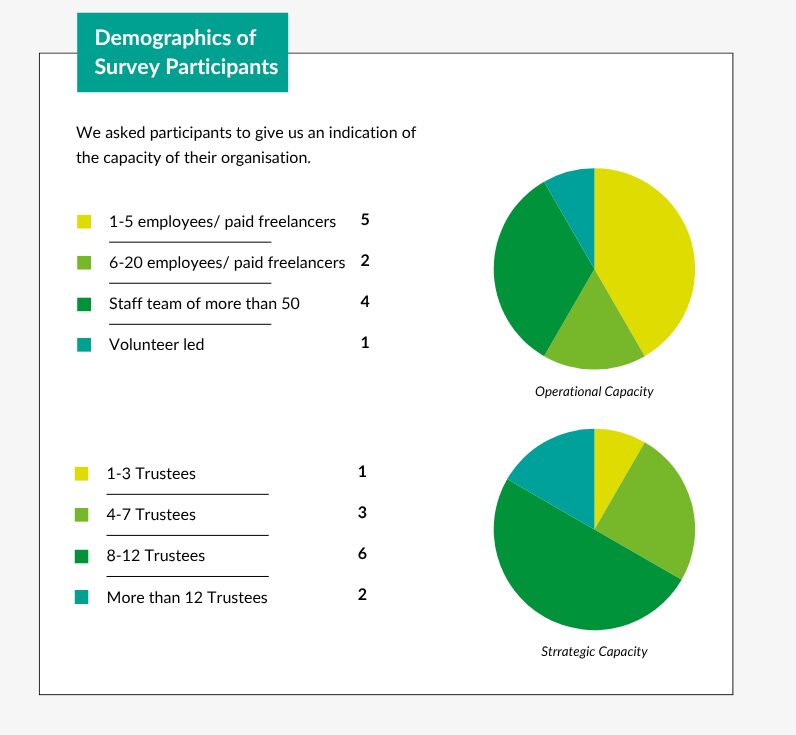
To help us understand the different challenges facing different organisations by size, we asked each organisation to identify their capacity, both in terms of their operations and their governance.
We are grateful to all our members who shared their views and experiences with us — thank you.
What ‘decolonisation’ means to our members
We know that defining decolonisation is problematic because it involves questions of power and privilege, history and politics — all of which look different depending on where you are standing. It is also more about moving away from and unlearning existing systems than moving towards a clearly defined goal. Because of this, it can sometimes feel easier to define by what it’s not, rather than what it is. Decolonisation is therefore best defined by our individual and organisational histories and politics, and the opportunities, relationships and structures we work with.
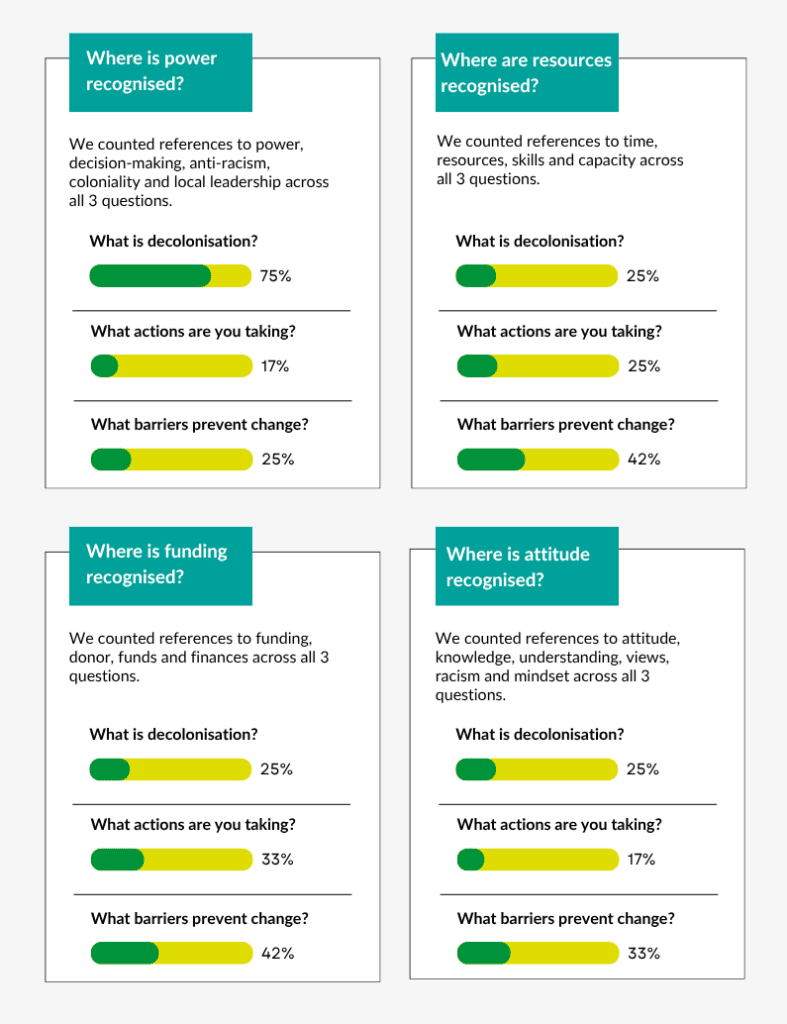
Academics working in decolonisation write about this complex messiness and some avoid definitions altogether as a result (Olivia Rutazibwa 2020), but we also hear from our members the frustration around this absence of clarity and how this, in itself, is a barrier to progress. So when we asked how our members would define decolonisation, we were really interested to read their replies. For more than 75% of them, power, decision-making, anti-racism, anti-coloniality and local leadership were mentioned in their response. When asked what their understanding of decolonisation was, they told us:
‘Decolonising is acknowledging the problematic colonial history and practice of Development to date and doing our best to move away from the paternalistic model often practiced by the GlobalNorthtowards the Global South/Majority in policy, practice, language and funding models.’
‘Ensuring that people with lived experiences have a real voice in design and delivery of projects and that media and images are respectful, with informed consent and do not perpetuate the white savior complex in its messaging.’
‘Decolonisation focuses on making visible and dismantling the colonial beliefs that continue to determine the ways in which power is distributed, who can use it ‘legitimately’ and how. It’s a needed and vital step to achieve equality and economic justice in humanitarian and rights based work.’
‘Identifying and removing the power imbalances, injustices and prejudices that have their roots in colonialism, but still persist today.’
We also had some feedback that members did not see decolonisation as directly relevant to their work, identified it only in relation to a geographical area, or felt this was nothing new to them or their way of working. When we asked what decolonisation means, some members said the following:
‘Working at the request of local communities [but] we work in a country that was never colonised.’ (paraphrased for anonymity)
‘To get the overseas partners to steer the agenda.’
‘Being intentional about re-balancing power in Africa.’
What are organisations doing in practice?
We were really interested to read the range and breadth of work being done by member organisations towards decolonisation, across all levels of their work. Some members gave us significant detail about their policies and processes, designed to maximise local leadership and minimise UK influence and oversight. Others talked about long-term strategy, including exit plans for UK organisations and anti-racist governance structures. We also heard about language use, programme design, funding models, prioritising racially diverse teams and organisational learning. Many talked about work they have always done, which only now is being understood as contributing to decolonisation. This confirmed for SWIDN that so much of the work to decolonise international development isn’t new and isn’t being captured.
When asked what actions that each organisation is taking to decolonise practice, our members said:
‘We have a long-term plan for a locally-registered entity to be set up in some of the countries we operate in so that our work can be effectively run entirely by local experts and actors in those countries. It’s a form of exit plan.’
‘We have an established decolonisation and antiracism unit working to unpack approaches across all projects and aspects of our work. This has set targets and priorities for the coming years.’
‘Unrestricted funding and governance support to one of our country entities will enable them to be fully independent from us in the next 12 – 18 months.’
‘We have an organisation wide decolonisation learning series which also covers fundraising.’
‘In order to reduce the reliance on the funding from the UK we are working together with the NGO to develop funding opportunities independently of the UK to allow greater freedom and sustainability into the future.’
‘We avoid the word beneficiaries and talk instead about the communities we work with. We are transparent that we do not carry out the work ourselves but through our trusted local partner who has the skills and ability to deliver the projects that we fund. Where possible, we look for opportunities for them to be funded directly, rather than through us as we acknowledge that this perpetuates an unjust system of fundraising.’
‘Our Theory of Change is one based on empowerment and collaboration with local government so that we do not create a parallel system of aid when we could be strengthening local health systems instead.’
‘The structure at our organisation is created in a way to create decolonisation. We have two organisations – one in the UK and one in [the country where we work] – and we are separately governed, separately constituted, yet we work together as partner organisations.’ (paraphrased for anonymity)
‘We have a racially diverse staff team in the UK, which is very helpful. The team in [the country where we work] is entirely made up of country nationals, who lead and run the organisation.’ (paraphrased for anonymity)
There were also some who expressed that their work has always been anti-colonial. This is a perspective we see far more amongst our micro and small charity members, for whom core tasks such as programme design, delivery and decision-making, etc have always been located with implementing partners and community members, as a result of limited capacity as much as values and approach.
‘This is what we have always done.’
‘We have a [nationally] registered NGO which drives strategy.’ (paraphrased for anonymity)
‘All our projects are designed by and with our local communities and partners. All training is delivered by local trainers whom we have been working for over 20 years, in some cases.’
The biggest barriers to change
Like many organisations in the sector, SWIDN members feel that the structure of international development is the biggest barrier to change and progress that they, as organisations within that structure, experience. This looks like both attitude and knowledge, funding and finance systems, and political will to address power imbalances.
We were really interested to read how many people identified knowledge and understanding as a barrier. This was seen, not just amongst individuals, but amongst systems as well.
‘Old, entrenched views in the UK [are the biggest barrier preventing our organisation from taking actions to decolonise practice] – you can understand it but there simply isn’t enough education here.’
“The biggest barrier preventing us from taking actions to decolonise practice is the lack of unanimity as to what is ‘decolonisation’, or what is required and for who, and why added resources should be invested to address a poorly defined problem with indeterminate benefit.”
‘Staff must all be well informed and on board which can also take time.’
‘Society’s colonial structures and structural racism are hindering our progress.’
Funds, donors, finances and funding were mentioned in an average of 33% of the responses we received but, in relation to barriers preventing progress on decolonisation, this increased to 42%. Strongly linked to UK-centric funding models, was the issue of power, including who has it and who doesn’t. When asked what the biggest barriers preventing progress on decolonisation, people identified the following:
‘Financing, decision making and power still largely held in the UK due to our donor base being mainly in the UK.’
‘Funding reliance on UK and western donors.’
‘The UK funding model that prevents direct funding going to our trusted local partner. I wish I could do myself out of a job and be more of a broker by recommending them to funders who could then work with them directly like we do! The other issue is the short-term project-based nature of most funding that means it is restricted and time sensitive which means it is harder for national and overseas organisations to invest in themselves and grow sustainably.’
‘The leverage that large donors wield over the funds they provide.’
What could make the biggest difference?
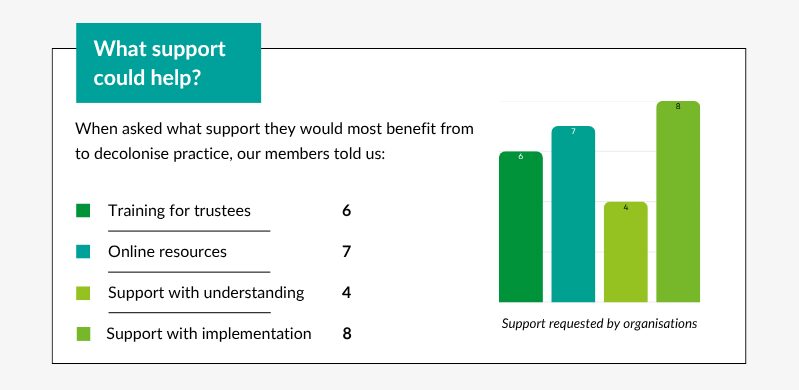
We finished by asking our members what support they would most benefit from to decolonise their practice, offering four options to choose from and space to add their own.
For those members who identified their own requests for support, some were clear that there isn’t a need or that the need is outside the UK.
‘We don’t need any support in this area.’
‘I’m not sure.’
‘Training and workshops to build skills capacity locally in the countries we operate.’
Identifying the common themes
We were interested to identify the commonalities across all three questions. Considering four common themes that we found ran through the responses, we used a text analysis tool to count how often and where these themes emerged. These four themes were power, resources, funding and attitude, and the infographic below shows what we found:
Next steps
Our hope is that these findings foster and support open discussion around what decolonisation means in practice. By creating space for people and organisations to engage in the conversation, we aim to resource learning and action around both the challenges and the benefits of change.
SWIDN are funded by the UK Government to support our members to collaborate and transform to become more locally led, anti-racist, and accountable organisations that respond effectively to the priorities of global majority communities. Independently of our funding, we are committed to pursuing antiracist practice and to decolonising international development. We see this as a continuous journey and, each year, we try to move forward on that path alongside our members.
In 2026, we will be responding to the issues raised in this survey, including with:
- publishing a blog series focusing on decolonisation and providing online resources, including blogs, recordings, toolkits, surveys (this will go live in June)
- delivering an open access, online workshop to engage with decolonisation experts and connect with peers, planned for 25 June 2026 (Register here)
- feeding into a panel discussion at the European Association of Development Training and Research Institutes (EADI) in July 2026
- contributing to a research article, together with partners at the Universities of Bristol, Leeds, London South Bank, University Kassel (Germany) and Örebro (Sweden)
- sharing learning and experiences with the Foreign, Commonwealth and Development Office (FCDO), with whom we meet quarterly alongside our peers in the UK Alliance
More News
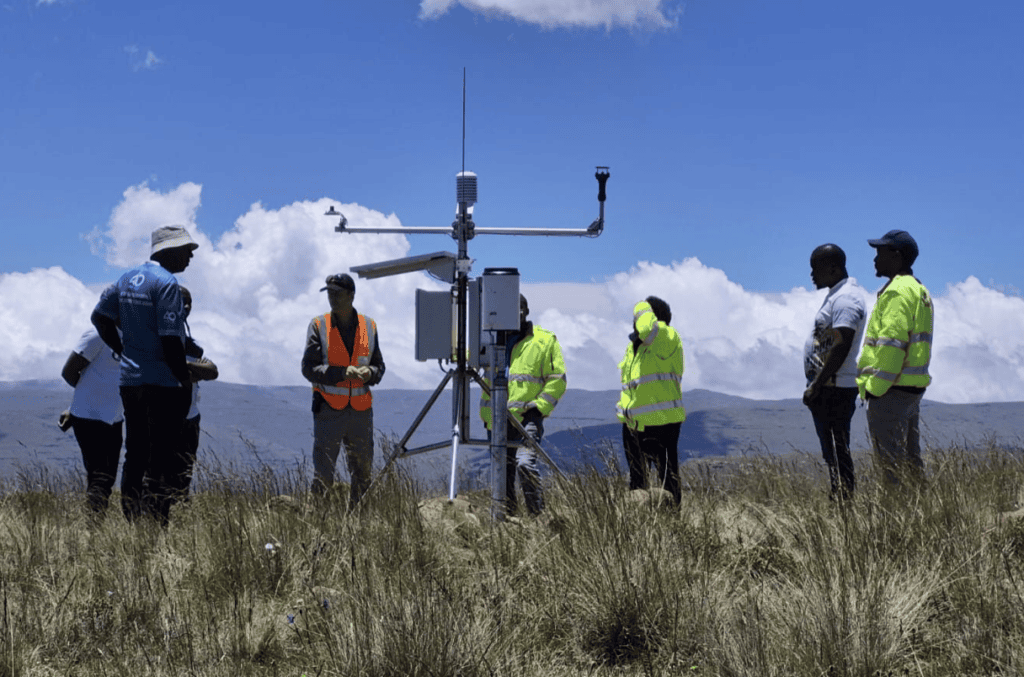
Spotlight on the African Mountain Research Foundation: Monitoring the Mountains that Shape a Continent
High up in the mountains of southern Africa — in Zimbabwe, Malawi, South Africa, and Lesotho — a quiet network of weather stations is generating data that could help predict the next drought, the next flood, the next climate shock for millions of people living in the valleys below. That network belongs to SWIDN Member…
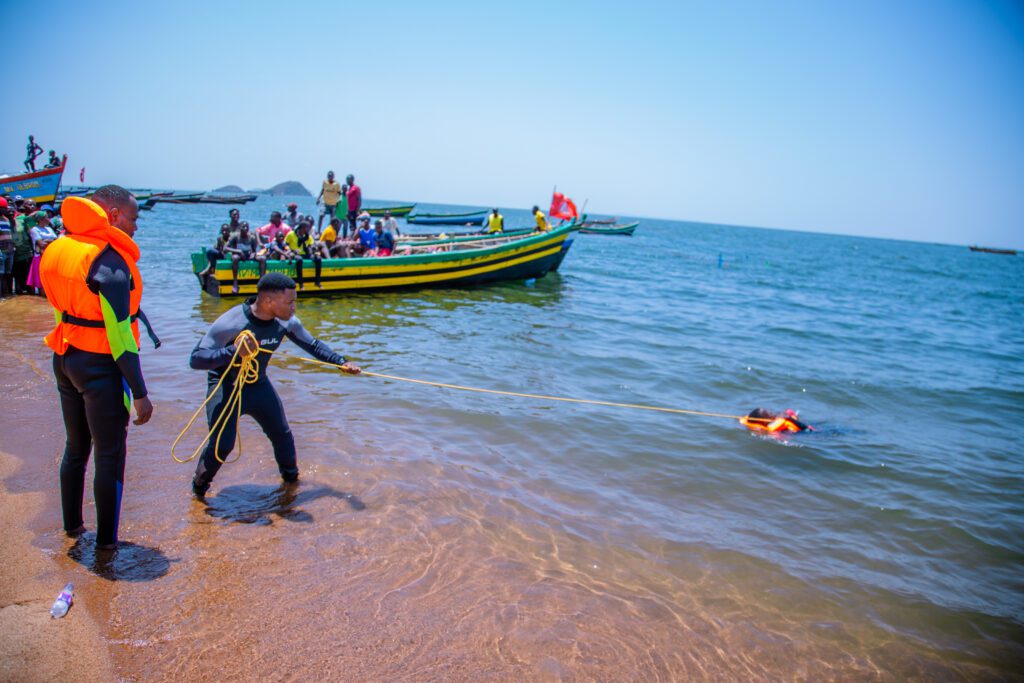
Beyond the Lifeboat: How the RNLI is Tackling Drowning in Tanzania, and the Programme Management That Makes It Work
Rachel Roland has spent more than 35 years working in Global Justice — and if there’s one thread that runs through all of it, it’s a deep commitment to understanding communities on their own terms. Now a Senior International Programme Manager at the RNLI, Rachel is leading the organisation’s drowning prevention work in Tanzania, bringing…

Changing the Story: How The Advocacy Team Is Reconnecting the Public with Global Justice
Lorriann Robinson is the founder and lead of The Advocacy Team, a consultancy helping organisations navigate political influence, shape policy, and reimagine how the case for global justice is made. We spoke with her about her work, the projects keeping her team busy, and why she believes the sector’s most difficult moment might also be…